AC vs DC Current: Complete Guide to Electrical Current Types
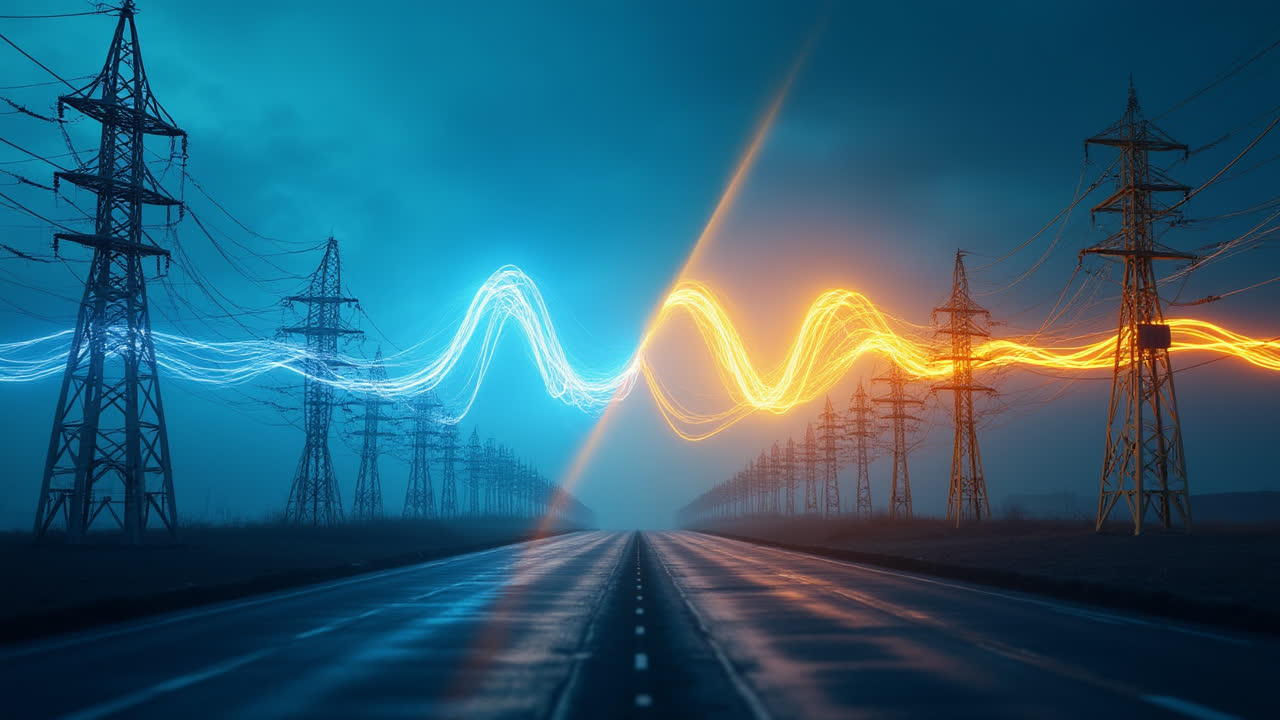
Electricity powers our modern world in countless ways, from lighting our homes to running complex industrial machinery. At the heart of this electrical revolution are two fundamental types of current: Alternating Current (AC) and Direct Current (DC). While both carry electrical energy, they do so in remarkably different ways, each with unique characteristics and applications. Have you ever wondered why we use AC in our homes but DC in our electronic devices?
The fundamental distinction between these two current types shapes our entire electrical infrastructure. In this comprehensive guide, we'll explore the key differences between AC and DC current, their practical applications, advantages, limitations, and the fascinating historical battle known as the "War of Currents" that determined how electricity would be delivered to the world.
What is Direct Current (DC)?
Direct Current, commonly abbreviated as DC, is an electrical current that flows consistently in one direction. When we connect two points at different electrical potentials using a conductor, electrons move from the more negative potential toward the less negative potential, creating a steady, unidirectional flow. This is the simplest form of electrical current and was the first type to be harnessed for practical applications.
For example, if we connect a wire between points at -5V and -2V, electrons will flow from the -5V end toward the -2V end. Interestingly, the conventional direction of current is opposite to the actual electron flow—a historical quirk from the early days of electrical science when the nature of electricity wasn't fully understood. So while electrons physically travel from negative to positive, we typically diagram current flow from positive to negative.
DC power sources maintain a constant voltage over time, providing a steady electrical potential. The most familiar examples of DC power sources include batteries, solar cells, and fuel cells. When you use a battery-powered flashlight or charge your smartphone, you're utilizing DC current. Most electronic devices we use daily—from laptops to LED lights—operate using DC internally, even if they're plugged into an AC power outlet.
The stability of DC makes it ideal for sensitive electronic components and precise applications. Computing devices, including your smartphone and computer, process information using incredibly small DC currents that flow through millions of transistors. This predictable, steady current allows for the reliable operation of complex digital systems where timing and precise voltage levels are critical.
What is Alternating Current (AC)?
Alternating Current, or AC, features a flow of electrons that periodically reverses direction. Unlike the steady, one-way flow of DC, AC current oscillates back and forth in a circuit. This oscillation typically follows a sinusoidal pattern, with the voltage and current smoothly rising to a maximum in one direction, falling to zero, then increasing to a maximum in the opposite direction before returning to zero and repeating the cycle.
In an AC circuit, one conductor is typically connected to a potential that varies sinusoidally between positive and negative values, while the other is maintained at a reference potential (usually ground or 0V). As the potential difference changes, electrons in the conductor are pushed and pulled in alternating directions. This continuous oscillation creates the distinctive waveform we associate with AC power.
The frequency of AC current refers to how many complete cycles occur per second, measured in Hertz (Hz). Different countries have standardized on different frequencies for their power grids. Most of the world, including Europe and Asia, uses 50Hz, while North America operates on a 60Hz system. These differences evolved historically as electrical systems developed independently around the world.
Since AC constantly changes direction and magnitude, measuring its "voltage" requires a special approach. We use Root Mean Square (RMS) voltage to characterize AC power, which gives us an equivalent DC voltage that would produce the same heating effect. For a sinusoidal AC voltage, the RMS value is approximately 0.707 times the peak voltage. When we say household electricity is 120V or 230V, we're referring to the RMS voltage, not the peak.
The Historical "War of Currents"
The late 19th century witnessed one of the most significant technological debates in history—the infamous "War of Currents." This heated competition pitted Thomas Edison, advocate for DC distribution, against Nikola Tesla and George Westinghouse, champions of AC power. This wasn't merely a technical disagreement but a battle with enormous economic stakes that would determine the future of electrical infrastructure worldwide.
Edison had established his electrical business using DC technology and had invested heavily in its development. He argued that DC was safer and more reliable for consumers. To defend his business interests and technological approach, Edison reportedly went to extreme lengths to discredit AC current, including public demonstrations where animals were electrocuted using AC to portray it as dangerously lethal—a controversial publicity campaign known as "electrocuting an elephant."
On the other side, Tesla and Westinghouse recognized the fundamental advantage AC held for power transmission over long distances. At the time, the biggest challenge facing electrical systems was efficiently transmitting power from generation stations to distant homes and businesses. With the technology then available, AC could easily be transformed to higher voltages using transformers, while DC could not. Higher voltage meant lower current for the same power, resulting in dramatically reduced transmission losses over long distances.
The turning point came when Westinghouse won the contract to harness Niagara Falls for hydroelectric power and to light the 1893 World's Columbian Exposition in Chicago using AC. These high-profile successes demonstrated AC's practical advantages on a large scale. Eventually, Edison's own company, General Electric, adopted AC technology, effectively conceding that AC was superior for power distribution. This historical competition shaped our modern electrical infrastructure, with AC becoming the global standard for power transmission and distribution networks.
Key Differences Between AC and DC Current
| Characteristic | Direct Current (DC) | Alternating Current (AC) |
|---|---|---|
| Direction of Flow | Electrons flow in one direction only | Electrons oscillate back and forth periodically |
| Waveform | Constant voltage (flat line) | Sinusoidal wave (in most applications) |
| Power Stability | Power remains nearly constant | Power varies continuously |
| Typical Sources | Batteries, solar cells, fuel cells | Power plants, generators |
| Transmission Efficiency | Less efficient over long distances | More efficient for long-distance transmission |
| Voltage Transformation | Requires complex electronic converters | Easily transformed using transformers |
| Cabling Requirements | Two cables (positive and negative) | Three or four cables for three-phase systems |
| Common Applications | Electronics, batteries, solar systems | Home and industrial power distribution |
Modern Applications and Usage
In today's world, both AC and DC current play essential roles in our electrical ecosystem. While the historical "War of Currents" established AC as the dominant form for power transmission, DC has found numerous specialized applications where its unique properties provide advantages. The distinction between these current types has become increasingly important as our energy infrastructure evolves to include renewable sources and high-efficiency systems.
AC power dominates our electrical grid and home wiring systems. Power plants generate electricity as AC, and it's transmitted efficiently over long distances at high voltages before being stepped down by transformers for residential and commercial use. Most household appliances—refrigerators, washing machines, air conditioners—are designed to run directly on AC power. The alternating nature of AC makes it particularly suitable for electric motors, as the changing polarity naturally creates rotating magnetic fields that drive motor rotation.
Meanwhile, DC power excels in applications requiring precise control, stability, or energy storage. Virtually all electronic devices operate using DC internally. When you plug a laptop, phone charger, or TV into an AC outlet, a power supply inside the device converts AC to DC. Batteries, which store and release energy through chemical reactions, can only provide DC power. This makes DC essential for portable devices, vehicles, and backup power systems. Solar panels also generate DC electricity directly, requiring inverters to convert their output to AC for grid connection.
Interestingly, high-voltage direct current (HVDC) transmission has seen a resurgence in recent decades. Modern power electronics have made it practical to convert between AC and DC efficiently, enabling HVDC to overcome its historical limitations. HVDC lines now connect distant power grids, carry electricity from offshore wind farms, and link power systems operating at different frequencies. These specialized applications highlight how both current types continue to evolve and find their optimal niches in our electrical infrastructure.
Frequently Asked Questions
Why do we use AC for homes but DC for electronics?
We use AC for homes primarily because it's more efficient for long-distance power transmission from generating stations to residential areas. AC can be easily transformed to higher voltages (with lower current) for transmission, significantly reducing power losses over long distances. Once at your home, this voltage is stepped down for safe use. Electronics, however, require DC because semiconductor components like transistors, diodes, and integrated circuits need constant voltage and current direction to function properly. This is why devices have power supplies or adapters that convert AC from wall outlets into the DC voltage needed by the electronic components inside.
Can AC and DC current be converted from one to another?
Yes, AC and DC can be converted between each other using specialized electronic components. Converting AC to DC (rectification) is achieved through rectifiers, which use diodes to allow current flow in only one direction, effectively "straightening out" the alternating current. Power supplies in electronics like computer chargers and phone adapters perform this conversion. Converting DC to AC (inversion) is done with inverters, which use switching circuits to create an alternating output from a DC source. Solar power systems use inverters to convert the DC electricity from solar panels into AC for home use or grid connection. Both conversion processes have become more efficient with advances in power electronics.
Which is more dangerous, AC or DC current?
Both AC and DC can be dangerous, but they pose different risks. AC is generally considered more dangerous at lower voltages because it causes muscle contractions that can prevent a person from letting go of a live conductor, potentially prolonging exposure. AC also interferes with the heart's electrical system more readily, potentially causing fibrillation. However, DC can cause a single strong muscle contraction and sustained DC can lead to tissue heating and burns. The danger of either type increases with voltage, current, duration of contact, and path through the body. This is why all electrical systems require proper safety measures regardless of whether they use AC or DC.
Conclusion
The distinction between AC and DC current represents one of the most fundamental concepts in electrical engineering, with implications that extend throughout our modern technological society. From the historical "War of Currents" to today's sophisticated power systems, understanding these two forms of electrical energy helps us appreciate the complex infrastructure that powers our daily lives.
While AC won the initial battle for power distribution due to its transmission advantages, both current types have found their optimal applications in our electrical ecosystem. AC powers our homes and industries, while DC enables the personal electronics revolution and is increasingly important in renewable energy systems and high-efficiency transmission technologies.
As we move toward a more electrified future with renewable energy sources, electric vehicles, and smarter grids, the interplay between AC and DC will continue to evolve. The electrical currents that Edison and Tesla once debated now coexist in complementary roles, each leveraging its unique strengths to meet the diverse energy needs of our modern world.