Facebook
Pin
Email
(📅 Update Date: Mar 17, 2026)
When it comes to cellular signaling, few molecular switches are as important as monomeric and trimeric G proteins. These remarkable proteins act as critical intermediaries in signal transduction pathways, relaying information from outside the cell to its interior. Have you ever wondered how your cells know when to respond to external stimuli? Well, the answer lies partly in these fascinating protein structures.
Let me paint you a picture. Imagine you're standing in a crowded room, and someone at the far end shouts your name. You hear it because the sound waves travel through the air, and your ears convert this signal into electrical impulses your brain can understand. Similarly, cells need messenger systems to detect and respond to signals from their environment, and G proteins fill this crucial role.
What Exactly Are G Proteins?
G proteins, short for guanine nucleotide-binding proteins, are like molecular light switches that can turn cellular processes on or off. These versatile proteins bind to either GDP (guanosine diphosphate) or GTP (guanosine triphosphate), which determines whether they're in their "off" or "on" state, respectively.
Think of G proteins as tiny molecular machines that exist in two main forms: the larger trimeric G protein and its smaller cousin, the monomeric G protein. These proteins work hand-in-hand with G protein-coupled receptors (GPCRs), which span the cell membrane seven times - hence their nickname "7TM receptors."
What's fascinating about G proteins is their ability to translate extracellular signals into intracellular responses. When signaling molecules like hormones or neurotransmitters bind to their receptors, G proteins spring into action, initiating a cascade of cellular events that can affect everything from metabolism to gene expression.
The Structure of Monomeric G Proteins
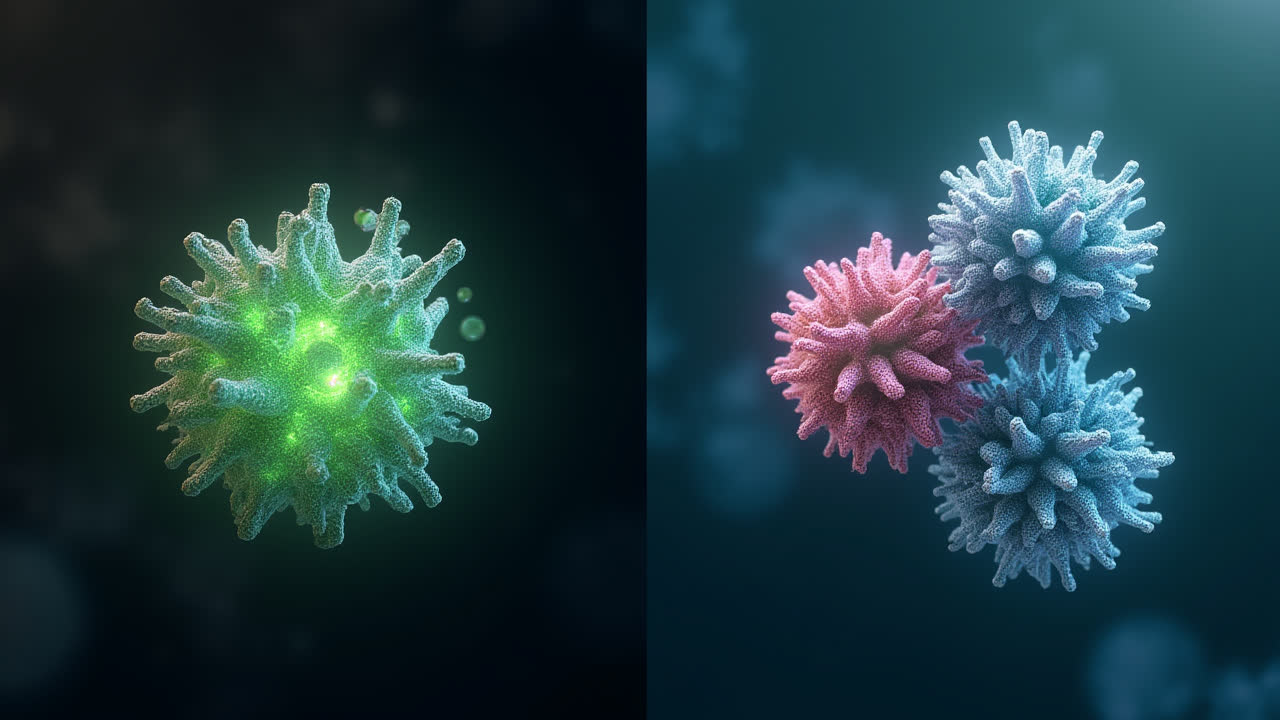
Monomeric G proteins are streamlined, consisting solely of the alpha subunit that has broken free from its larger trimeric partner. This sleeker structure allows them to move more freely within the cell, acting as nimble messengers that can quickly reach their target proteins.
You might wonder: how does this simplification happen? When a G protein-coupled receptor gets activated by an external signal, it triggers a dramatic molecular transformation. The trimeric G protein undergoes a structural change that causes its three subunits to separate, with the alpha subunit going solo while carrying its GTP cargo.
The monomeric form represents the "active" state of the G protein. In this configuration, the alpha subunit can bind to and activate various downstream effector proteins, including enzymes, ion channels, and other signaling molecules. It's like releasing a trained delivery person with a specific package, ready to complete their mission.
Understanding Trimeric G Proteins
In stark contrast to their monomeric counterparts, trimeric G proteins are complex molecular assemblies consisting of three distinct subunits: alpha, beta, and gamma. This trio works together in the inactive state, much like a three-part puzzle that must be assembled correctly to function properly.
The beta and gamma subunits form a tight complex that remains associated with the plasma membrane through lipid anchors. Meanwhile, the alpha subunit acts as the business end of the molecule, binding GDP in the inactive state and waiting patiently for its activation signal.
Here's something interesting: the trimeric form serves as a safety mechanism for the cell. By keeping the G protein in its inactive state when not needed, the cell prevents unwanted activation of signaling pathways. It's like having a secure lock on a door that only opens when the right key (in this case, an activated receptor) turns it.
Key Differences Between Monomeric and Trimeric G Proteins
| Feature |
Monomeric G Protein |
Trimeric G Protein |
| Subunit Composition |
Only alpha subunit |
Alpha, beta, and gamma subunits |
| Activation State |
Active form |
Inactive form |
| Nucleotide Binding |
Binds GTP |
Binds GDP |
| Size |
Small (single subunit) |
Large (three subunits) |
| Location |
Freely mobile in cytosol |
Associated with plasma membrane |
| Primary Function |
Activate downstream effectors |
Serve as receptor-associated complex |
| Interaction Partner |
Effector proteins |
G protein-coupled receptors |
| Lifespan |
Transient (inactivated by GTP hydrolysis) |
Stable until receptor activation |
Functional Significance in Cell Signaling
Let's talk about why this dual-form system is so clever. The transformation from trimeric to monomeric G protein represents a molecular switch that provides exquisite control over cellular responses. When cells need to respond to environmental signals, the trimeric-to-monomeric transition ensures rapid activation of specific pathways.
For instance, in the adrenergic signaling pathway (think "fight or flight" response), trimeric G proteins bound to beta-adrenergic receptors wait quietly until epinephrine (adrenaline) arrives. Once activated, the alpha subunit breaks free, binds GTP, and activates adenylyl cyclase, leading to increased production of cyclic AMP - a crucial second messenger molecule.
But there's a safeguard built into this system. The monomeric G protein's activity is self-limiting because it contains an intrinsic GTPase activity. This means it slowly hydrolyzes its bound GTP back to GDP, eventually reassociating with the beta-gamma complex to reform the inactive trimeric structure. It's nature's way of preventing runaway cellular responses that could be harmful.
Similarities That Connect These Forms
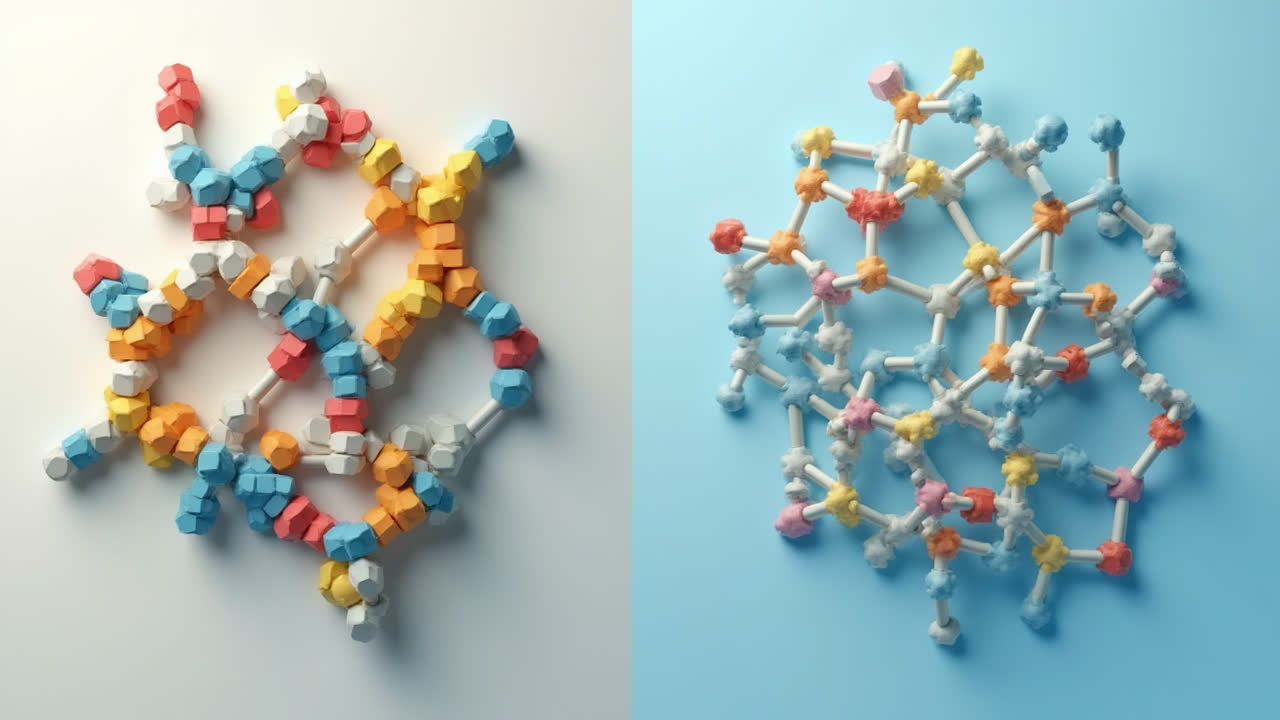
Despite their differences, monomeric and trimeric G proteins share some fundamental characteristics that make them part of the same functional family. Both forms are essential for G protein-coupled receptor signaling, and both utilize the biochemical properties of guanine nucleotides to regulate their activity.
They both operate within the cytosolic face of the plasma membrane, though monomeric forms have more freedom of movement. Additionally, both forms serve as relay proteins, connecting receptors to their downstream targets. This shared purpose creates a seamless molecular machine that can respond to countless different signals while maintaining specificity and control.
Whether in their active or inactive states, these proteins exemplify the elegant design of cellular communication systems. They demonstrate how a single protein family can operate in multiple conformations to achieve precise regulation of cellular processes.
Clinical and Research Implications
Understanding the differences between monomeric and trimeric G proteins isn't just academic curiosity - it has real-world implications for drug development and medical research. Many pharmaceuticals target GPCRs, making G protein function a critical consideration in drug design.
For example, conditions like cholera result from bacterial toxins that permanently activate G proteins by preventing GTP hydrolysis. This keeps the protein in its active state, leading to uncontrolled cellular responses. Conversely, some diseases involve underactive G protein signaling, where the monomeric form fails to properly activate downstream effectors.
Current research is exploring ways to modulate G protein activity more precisely, potentially leading to more effective treatments with fewer side effects. The ability to fine-tune the transition between trimeric and monomeric states could revolutionize how we approach certain diseases.
Future Perspectives
As our understanding of G protein dynamics grows, so do the possibilities for therapeutic intervention. Scientists are developing novel approaches to target specific aspects of G protein function, from inhibiting the dissociation of trimeric complexes to enhancing the activity of monomeric forms.
One particularly exciting area is the development of allosteric modulators - molecules that can fine-tune G protein activity without directly interfering with nucleotide binding. These compounds could offer more nuanced control over cellular signaling, potentially avoiding the all-or-nothing effects of traditional GPCR drugs.
The journey to fully understanding these molecular machines continues, with each discovery opening new avenues for investigation. What remains clear is that the interplay between monomeric and trimeric G proteins represents one of nature's most elegant solutions to the challenge of cellular communication.
FAQs
What causes a trimeric G protein to become monomeric?
When a G protein-coupled receptor becomes activated by binding to a signaling molecule (like a hormone), it induces a conformational change in the associated trimeric G protein. This triggers the exchange of GDP for GTP on the alpha subunit, causing it to dissociate from the beta-gamma complex and become a monomeric G protein.
Can monomeric G proteins reform into trimeric complexes?
Yes, monomeric G proteins are not permanently separated. The alpha subunit contains GTPase activity that hydrolyzes its bound GTP back to GDP. Once GDP is bound, the alpha subunit loses its affinity for effector proteins and reassociates with the beta-gamma complex, reforming the inactive trimeric structure.
Are there different types of alpha subunits in trimeric G proteins?
Yes, there are multiple families of alpha subunits (Gαs, Gαi, Gαq, Gα12/13) that determine which downstream effectors will be activated. These different alpha subunits allow the same receptor to trigger diverse cellular responses depending on which G protein complex it's associated with.